
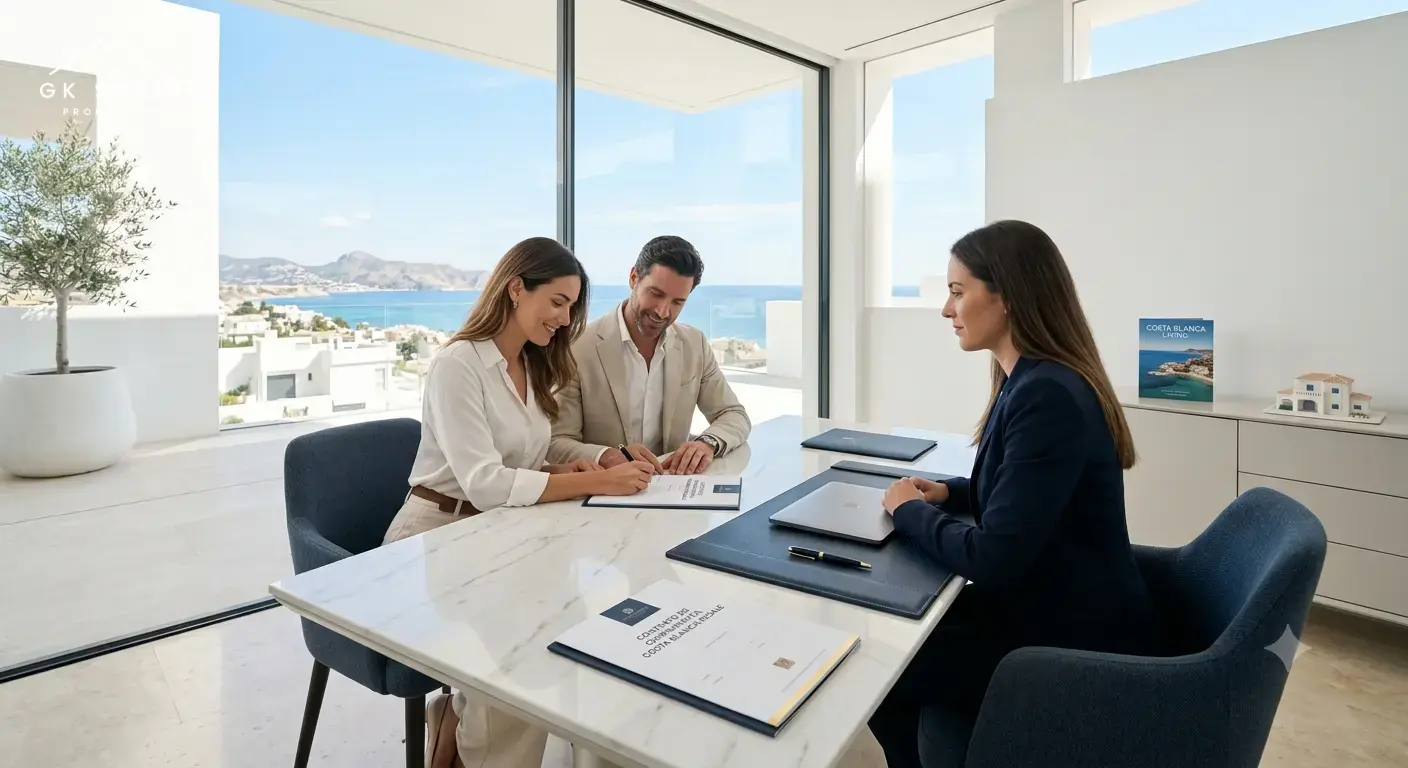
Buying a Resale Property on the Costa Blanca – Complete Guide 2026

ITP Tax · Legal Due Diligence · Deposit Contract · NIE Number · Step-by-Step Process
Introduction: Why Is Buying a Resale Property Different?
On the Costa Blanca property market, there are two purchasing routes: buying a new-build property from a developer, or buying a resale property from an individual or company. The difference is not just in price and condition — the entire legal and financial process is different.
With a new-build, the developer guides you through the process: there is a bank guarantee, statutory warranty on construction defects, and the property starts with a 'clean slate' — no history behind it.
With a resale property, there is no such safety net. The property has a history: previous owners, possible mortgages, tax debts, court cases, illegal extensions, inheritance disputes. These are not visible to you — only a qualified lawyer can uncover them.
This guide takes you through the entire process — from the NIE number, through the taxes, to the handover of keys. It also explains why the lawyer is the most important investment throughout the entire purchase.
Note for Non-EU Buyers
Citizens from outside the European Union (e.g. from the UK, USA, Australia, Canada, UAE, or any non-EU country) can buy property in Spain on exactly the same terms as EU citizens. Spain does not restrict foreign ownership of real estate. However, there are some practical differences:
- You will need a NIE number regardless of nationality (explained in Section 1).
- Opening a Spanish bank account may require additional documentation (e.g. proof of source of funds, certified ID translation).
- Mortgage availability is more limited for non-residents — especially those with income in non-euro currencies (see Section 3.3).
- For non-EU buyers, it is especially important to hire an independent lawyer, as you may be unfamiliar with Spanish legal processes.
- If you are from the UK, note that post-Brexit rules apply: UK citizens are treated as non-EU nationals in Spain.
1. The First Step: NIE Number
Before starting any Spanish property purchase — whether new-build or resale — you need a NIE number (Número de Identificación de Extranjero). This is your Spanish tax identification number. Without it, the notary will not execute the purchase contract and the bank will not open an account for you.
What Is a NIE Number? (for non-EU readers)
The NIE is Spain's equivalent of a tax ID or social security number for foreigners. Every person who buys property, opens a bank account, or pays tax in Spain must have one — regardless of nationality.
How to get it:
- If you are in Spain: Apply in person at a National Police station (Comisaría de Policía) or a Foreigners' Office (Oficina de Extranjeros). You will need your passport, a completed EX-15 form, and a fee (around €10).
- From abroad: Apply through the Spanish Consulate or Embassy in your home country.
- Via a lawyer (recommended): Your Spanish property lawyer can apply for the NIE on your behalf using a Power of Attorney (Poder Notarial), so you do not need to travel to Spain just for this.
Processing time: 2–6 weeks depending on the office. Apply as early as possible.
You can find the details on applying for a NIE number and opening a bank account in our dedicated guide.
NIE Number in Spain – Complete Guide 2026
Opening a Bank Account in Spain 2026 – Complete Guide for Property Buyers
2. The Role of the Lawyer — The Most Important Section
If you read only one section of this entire guide, let it be this one. When buying a resale property, the lawyer is not an optional extra — they are the only person who protects you.
What Does a Good Spanish Property Lawyer Do?
The lawyer's job is to carry out a full legal review of the property (Due Diligence) — this means examining every publicly available and requestable document about the property before you sign the contract.
1. Title Register Check (Nota Simple)
The Nota Simple is the property's 'identity document' — it shows who the current owner is, and whether the property has any registered mortgage, debt, easement or litigation. The lawyer requests this from the Registro de la Propiedad (Land Registry).
What Is the Nota Simple? (for non-EU readers)
In Spain, all property ownership and encumbrances are recorded in a public register called the Registro de la Propiedad (Land Registry). The Nota Simple is an extract from this register.
It is the Spanish equivalent of a title search or title report used in countries like the UK, US, or Australia. However, unlike some systems, the Spanish Land Registry operates on a 'first to register wins' principle — so your lawyer must check this before you pay any deposit.
The Nota Simple costs only €9 to obtain and is the single most important document in the purchase process.
What to look for:
- Mortgage: if the seller has a mortgaged property, the loan must be discharged from the purchase price — coordinated by the lawyer with the bank
- Liens or enforcement proceedings: if there is an active enforcement order on the property, this must be resolved before purchase
- Easements: for example, a right of way that could restrict your use of the property
2. Tax Debt Check
Any unpaid IBI (property tax) or community fee debt from the previous owner passes with the property — not the person. If the seller has 3 years of unpaid IBI, that becomes your problem after purchase.
The lawyer requests the document confirming IBI is fully paid, and the community certificate confirming the seller has no outstanding fees.
What Is IBI? (for non-EU readers)
IBI (Impuesto sobre Bienes Inmuebles) is Spain's annual council tax / property tax. It is paid to the local municipality (ayuntamiento) and is based on the cadastral value of the property. It is similar to council tax in the UK, property tax in the US, or rates in Australia.
Unlike personal debts, IBI debts attach to the property itself — not the person. This means if the previous owner did not pay for 3 years, those debts follow the property to the new owner. This is why your lawyer must obtain a certificate of cleared IBI before you complete the purchase.
3. Urban Planning Check (Urbanistic Check)
In Spain, it is unfortunately not uncommon for a property to have an illegal extension — an enclosed terrace, an unauthorised swimming pool, a converted garage. These do not legally exist, and if you buy the property, the problem becomes yours.
The lawyer checks that the property description matches the municipal register (Catastro), and that there is no demolition order on the building.
What Is the Catastro? (for non-EU readers)
The Catastro is Spain's official register of all real estate, managed by the national government. It records the physical description of each property: size, layout, legal use, and any registered structures.
The Catastro is separate from the Land Registry. A property can be registered as owned in the Land Registry but have an illegal extension that does not appear in the Catastro — or vice versa. Your lawyer must check both.
Illegal extensions are relatively common in older Spanish properties. If an extension was added without a building licence (licencia de obras), it may be subject to a demolition order — which becomes your obligation as the new owner.
4. Community Rules (Estatutos de la Comunidad)
If you are buying in an apartment block or urbanisation, the lawyer reviews the community rules — for example, whether short-term tourist rental is permitted, or whether there are pet restrictions the seller did not disclose.
5. Energy Performance Certificate
When selling a resale property, the seller is legally required to provide a valid Energy Performance Certificate (Certificado de Eficiencia Energética). The lawyer checks that this exists and is valid.
Energy Certificate (for non-EU readers)
This is Spain's equivalent of an EPC (Energy Performance Certificate) in the UK, or an energy rating label used in many EU countries. It rates the property from A (most efficient) to G (least efficient).
It is mandatory for all property sales and rentals in Spain. Without a valid certificate, the sale cannot be completed. The seller is responsible for obtaining and paying for it (cost: approx. €100–300 depending on property size).
How Much Does a Lawyer Cost?
Typically 0.5–1% of the purchase price — for a €300,000 purchase, that is €1,500–3,000. This is the safest investment in the entire purchase. An undiscovered mortgage or illegal extension can cost many times more.
How to Choose a Lawyer
- They must be independent — not recommended by the seller or the estate agent. The lawyer represents your interests, not the seller's
- They should have experience with foreign buyers and communicate in English (or your language)
- Request a written fee quote in advance — before signing the engagement letter
- Verify they are registered with the Spanish Bar Association (Colegio de Abogados)
Important for Non-EU Buyers: Power of Attorney
If you cannot be present in Spain at every stage of the process (which is common for international buyers), your lawyer can act on your behalf using a Power of Attorney (Poder Notarial).
This is a notarised document that authorises your lawyer to sign documents, apply for the NIE, open a bank account, and even complete the purchase on your behalf.
For non-EU buyers with limited ability to travel to Spain frequently, this is highly recommended. The Power of Attorney must be signed either in Spain before a Spanish notary, or at the Spanish Consulate in your country (or via an apostille-certified local notary).
3. The Purchase Process — Step by Step
3.1 The Offer and Negotiation
In the Costa Blanca resale property market, there is generally room to negotiate — especially if the property has been listed for some time. An offer can be made verbally or in writing.
Important: before accepting any written offer, your lawyer should already be working — at minimum the Nota Simple should have been requested, so you do not pay a deposit on an encumbered property.
3.2 The Deposit Contract (Contrato de Arras)
Once your offer is accepted, the next step is signing the deposit contract (Contrato de Arras) and paying the deposit.
What Is an Arras Contract?
Under Spanish law, the 'Arras Penitenciales' is a two-way guarantee:
- If you pull out of the purchase → you forfeit the deposit
- If the seller pulls out → they must repay double the deposit
This is important protection — but it only works if the deposit contract is correctly drafted. This is the lawyer's job.
The deposit amount: typically 10% of the purchase price — for a €300,000 property, that is €30,000.
Arras Contract (for non-EU readers)
The Arras Penitenciales contract is unique to Spanish law and has no exact equivalent in many other legal systems. It is more binding than a simple 'reservation deposit' in the UK, for example — where the seller can often pull out freely.
In Spain, the double-return rule is statutory under Article 1454 of the Spanish Civil Code. However, this only applies if the contract is correctly labelled as 'Arras Penitenciales' — not just a generic deposit agreement.
Key points your lawyer must include in the Arras contract:
- Exact property description (address, cadastral reference, floor area)
- Purchase price and payment schedule
- Deadline for notarial completion
- Seller's obligations (mortgage discharge, repairs)
- Withdrawal conditions (e.g. if mortgage application fails)
Never sign an Arras contract without your lawyer reviewing it first.
3.3 Mortgage Application (if needed)
If you also need a mortgage, this must be initiated immediately after signing the Arras contract — the bank needs 4–8 weeks for credit assessment. Align the notarial signing deadline accordingly.
For resale properties, Spanish banks typically finance 60–70% of the property value for non-residents. If your income is in a non-euro currency (e.g. GBP, USD, AUD), conditions are stricter.
Mortgage Rules for Non-EU / Non-Resident Buyers
Spanish mortgages are available to non-EU citizens, but the terms differ significantly from those available to Spanish residents:
- Maximum loan-to-value (LTV): 60–70% for non-residents (meaning you need a minimum 30–40% deposit).
- Non-euro income: If your salary is in GBP, USD, HUF, or another non-euro currency, banks apply stricter stress tests. Some banks cap LTV at 50% and require a minimum net income of approx. €2,500/month per applicant.
- Documentation: You will need to provide proof of income (3–6 months payslips or tax returns), bank statements, and proof of other assets. Non-EU citizens may also need to provide certified translations.
- Currency risk: If your income is not in euros, be aware that exchange rate fluctuations will affect your monthly repayment in your home currency.
- Non-resident withholding tax: If you sell the property in the future, Spain will withhold 3% of the sale price at source as a tax payment — applicable to all non-residents regardless of EU status.
Recommended: speak to a Spanish mortgage broker (gestor hipotecario) who specialises in non-resident applications.
3.4 Legal Due Diligence
While the mortgage application is in progress, the lawyer carries out the full Due Diligence — all the checks described in the previous section. This typically takes 2–4 weeks.
If a problem is found during due diligence:
- Minor problem (e.g. small IBI arrears): the seller can be asked to deduct it from the purchase price
- Medium problem (e.g. mortgage): completing the purchase is conditional on simultaneous discharge of the mortgage
- Serious problem (e.g. illegal extension with demolition order): withdrawal from the purchase and reclaim of the deposit — possible if the Arras contract is properly drafted
3.5 Notarial Completion (Escritura de Compraventa)
Once due diligence is clear and the mortgage is approved, the final deed of sale (Escritura de Compraventa) is signed before the notary.
Who is present:
- The seller (or their authorised representative)
- You as buyer (or your representative under Power of Attorney)
- The bank representative (if there is a mortgage)
- The notary
What Is a Notary in Spain? (for non-EU readers)
A Spanish notary (Notario) is a public official — not the same as a solicitor or lawyer. The notary's role is to authenticate documents and ensure they comply with Spanish law. The notary does NOT represent your interests.
In countries like the UK, USA, or Australia, a notary simply certifies signatures. In Spain (and most civil law countries), the notary plays a central role in property transactions: they read the full deed aloud, ensure both parties understand it, and authenticate the transfer.
However — critically — the notary does not check for hidden debts, illegal extensions, or community fee arrears. That is your lawyer's job. Do not confuse the two roles.
What happens at completion:
- Payment of the purchase price — by bank certified cheque (Cheque Bancario) or wire transfer
- Simultaneous discharge of the seller's mortgage (if any)
- Transfer of legal ownership to you
- You receive the keys
3.6 Taxes and Duties
Within 30 days of signing the Escritura, the following must be paid:
- ITP (9% in the Valencian Community) — the property transfer tax
- AJD (stamp duty) — does not apply to resale properties
Your lawyer or gestor (tax representative) typically handles this.
3.7 Land Registry Registration
After paying the taxes, the lawyer submits the documents to the Registro de la Propiedad (Land Registry). Registration typically takes 2–4 weeks — after which you are officially recorded as the owner.
3.8 Transferring Utility Contracts
After registration, the utility contracts are transferred into your name:
- Electricity (Iberdrola, Endesa)
- Water
- Internet and telephone
- IBI (property tax) — notification to the municipality (ayuntamiento)
4. ITP — The Resale Property Tax
When buying a resale property, instead of IVA (Spanish VAT), you pay ITP (Impuesto sobre Transmisiones Patrimoniales — property transfer tax).
Standard rate on the Costa Blanca (Valencian Community): 9%
On a €300,000 purchase, this is €27,000 — payable as a lump sum within 30 days of signing the Escritura.
ITP for Non-EU Buyers: What You Need to Know
ITP is a regional tax in Spain, which means the rate varies depending on which autonomous community the property is located in:
- Valencian Community (Costa Blanca, Alicante, Benidorm): 9%
- Andalusia (Málaga, Marbella, Nerja): 7%
- Catalonia (Barcelona area): 10%
- Madrid: 6%
- Canary Islands (Gran Canaria, Tenerife): 6.5%
Non-EU buyers pay exactly the same ITP rate as EU citizens or Spanish residents. There is no additional tax on foreigners buying property in Spain.
Important: ITP is based on the declared purchase price or the tax authority's reference value (valor de referencia), whichever is higher. If you buy at a below-market price, the tax authority may assess ITP on a higher base value.
Comparison with new-build:
| Resale Property | New-Build | |
|---|---|---|
| Main Tax | ITP 9% | IVA (VAT) 10% |
| Stamp Duty (AJD) | – | 1.5% |
| Total Tax Burden | ~10% | ~11.5% |
| On a €300,000 property | ~€27,000 | ~€34,500 |
5. Total Purchase Cost — Summary
| Item | Rate | On a €300,000 property |
|---|---|---|
| ITP (Transfer Tax) | 9% | €30,000 |
| Notary Fee | ~0.5% | €1,500 |
| Land Registry | ~0.3% | €900 |
| Lawyer's Fee | ~1% | €3,000 |
| Total | ~10.8% | ~€32,400 |
The deposit (10%) is not an additional cost — it is part of the purchase price, paid in advance.
Additional Costs for Non-EU Buyers to Budget For
In addition to the standard costs above, non-EU buyers may incur:
- Currency conversion costs: If you are buying with funds in GBP, USD, or another non-euro currency, factor in exchange rate risk and transfer fees. Consider using a specialist FX broker (e.g. Wise, Currencies Direct) rather than a bank for large transfers.
- Certified translations: Some documents (e.g. birth certificates, marriage certificates, income proof) may need certified translation into Spanish.
- Apostille fees: Official documents from non-EU countries may need an apostille stamp to be recognised in Spain.
- Additional travel costs: You may need to travel to Spain more than once during the process.
- Spanish income tax (IRNR): As a non-resident property owner, you will owe annual imputed income tax on the property even if you do not rent it out. This is typically 1.1–2% of the cadastral value × 24% (or 19% for EU/EEA residents). Your gestor will handle this.
6. Investment Purchases — The 2025 Tourist Licence Rule Change
If you are buying for investment and plan to rent short-term (Airbnb, Booking.com), the rule change that came into force on 3 April 2025 directly affects your purchasing decision. This is one of the most important points you will rarely find in other guides.
What Changed from 3 April 2025?
Under the amendment to the Spanish Horizontal Property Law (Ley de Propiedad Horizontal), any new tourist licence application now requires the approval of 3/5 of the community owners. This means that if a property does not have an existing valid tourist licence, and you want to obtain one, the community can vote against it — and an increasing number of communities are doing exactly that.
Why Is a Property with a Pre-2025 Licence More Valuable?
If a property already had a valid tourist licence (VT number in the Valencian Community) before 2 April 2025, that licence is preserved as an acquired right. On purchase, there is no new licensing process, no community vote required — only a simple modification declaration (declaración responsable de modificación) to the regional tourist register.
From an investment perspective, this creates a significant value difference: a property with an existing valid tourist licence in restricted areas (e.g. popular parts of Alicante or Valencia) has near-irreplaceable value, because an equivalent licence can no longer easily be obtained.
Three Things Your Lawyer Must Check
1. Is the Licence Still Active?
It is possible that the seller had a tourist licence, but it was subsequently cancelled — for example, because they deregistered it, or the authority revoked it due to inactivity. If the licence was cancelled, a new application falls under the 2025 rules, requiring 3/5 community approval.
Your lawyer must check the Valencian Tourist Register to confirm the licence is in active status.
2. The Last Community Meeting Minutes
The community can vote at any time with a 3/5 majority to prohibit new tourist licences in the building. This does not cancel existing old licences — but if the licence lapses for any reason, a new licence in that building can no longer be obtained.
Therefore your lawyer must request and read the minutes of the last community general meeting (Acta de la Junta de Propietarios). If the community has already voted to ban tourist licences, the existing licence becomes 'fragile' — if lost, it cannot be replaced.
3. The Timing of the Transfer is Critical
After purchase, the new owner must immediately submit the ownership change declaration (declaración responsable de modificación) to the tourist authority. If this is delayed and the authority notices a 'gap period' on the licence, reactivation may be problematic.
Summary: Questions to Ask the Seller and Your Lawyer
| Question | What the answer means |
|---|---|
| Does the property have a valid tourist licence? | If yes and pre-2025: high investment value |
| Is the licence in active status in the register? | If not active: a new application is required (3/5 vote) |
| Was a tourist rental ban discussed at the last community meeting? | If yes and approved: the licence has become fragile |
| When was the last tourist activity in the property? | A long gap may be suspicious |
Frequently Asked Questions
Is a lawyer legally required when buying a resale property in Spain?
It is not legally mandatory — but it is strongly recommended, and in practice indispensable. The lawyer is the only person who can verify that the property has no mortgage, tax debt, court case, illegal extension or inheritance dispute. You cannot uncover these yourself, and if they emerge after purchase, the problem is yours. The lawyer's fee (0.5–1%) is the best investment in the entire purchase.
What is a Nota Simple and why is it important?
The Nota Simple is the property's title extract — obtainable from the Spanish Land Registry (Registro de la Propiedad). It shows the current owner and all registered encumbrances: mortgages, liens, enforcement orders, easements. The lawyer requests this as the first step — never pay a deposit without a Nota Simple.
What is the Arras contract and what does losing the deposit mean?
The Arras Penitenciales is a two-way guarantee: if you withdraw from the purchase, you forfeit the deposit (typically 10% of the purchase price). If the seller withdraws, they must repay double the deposit. This only provides proper protection if the Arras contract is correctly drafted — the lawyer's responsibility.
How much ITP do you pay on the Costa Blanca on a resale property?
In the Valencian Community (Costa Blanca), the property transfer tax (ITP) standard rate is 9% of the purchase price. On a €300,000 purchase, that is €27,000, payable within 30 days of signing the deed of sale.
What happens if the seller has a mortgage on the property?
This is not an obstacle to purchase, but requires careful coordination. The outstanding mortgage balance must be paid directly to the seller's bank from the purchase price — coordinated by the lawyer and notary. On the day of signing, the mortgage discharge and ownership transfer happen simultaneously.
How long does a resale property purchase take?
From deposit payment to key handover, typically 6–12 weeks. This includes legal due diligence (2–4 weeks), mortgage assessment (4–8 weeks if required), and arranging the notarial appointment. In urgent cases this can be shortened, but do not rush — due diligence cannot be skipped.
Can there be an illegal extension on the property?
Unfortunately yes — in Spain it is not uncommon to find an unauthorised enclosed terrace, swimming pool or garage conversion. These do not legally exist, and after purchase they become your problem — potentially including a demolition obligation. The lawyer's urban planning check will uncover these before purchase.
Is a Spanish bank account necessary for a resale property purchase?
Yes — the bank-certified cheque (Cheque Bancario) required at the notarial completion can only be issued from a Spanish bank account. Details on opening a Spanish bank account can be found in our bank account guide.
What does the 3 April 2025 tourist licence rule change mean for investors?
From 3 April 2025, any new tourist licence application requires 3/5 approval from community owners. Licences issued before that date are preserved as acquired rights — on purchase, only a simple modification declaration is required. Therefore a property with a valid pre-2025 tourist licence has higher investment value. The lawyer must check the licence's active status and the last community meeting minutes.
Can non-EU citizens buy property in Spain?
Yes — Spain has no restrictions on foreign property ownership. Citizens of any country can purchase property in Spain on the same legal terms as Spanish nationals or EU citizens. You will need a NIE number and a Spanish bank account. Mortgage conditions are more restrictive for non-residents, especially those with non-euro income (see Section 3.3 for details).
Summary: The Purchase Process Timeline
| Step | When | What to do |
|---|---|---|
| NIE Number | As early as possible | At the Consulate, or in Spain (or via lawyer with PoA) |
| Spanish Bank Account | As early as possible | At least 4–6 weeks before signing |
| Engage a Lawyer | Before making an offer | Independent, experienced with foreign buyers |
| Request Nota Simple | Before paying deposit | Your lawyer handles this |
| Arras Contract & Deposit | After offer accepted | Typically 10% of purchase price |
| Mortgage Application | Immediately after Arras | 4–8 weeks for approval |
| Legal Due Diligence | In parallel | 2–4 weeks |
| Notarial Completion (Escritura) | When everything is in order | ITP payable within 30 days |
| Land Registry Registration | After Escritura | 2–4 weeks |
| Transfer Utility Contracts | After registration | Electricity, water, IBI |
Buying a resale property on the Costa Blanca is a safe and transparent process — if you do it with the right lawyer. The lawyer is not an extra cost, but the only safety net that protects you from buying someone else's problems.
Resale properties on the Costa Blanca – Browse available listings
New build properties on the Costa Blanca – Explore our latest selection
Last updated: 2026. Legal processes and tax rates are subject to change — always consult a qualified Spanish property lawyer.
If you have any questions, our team is happy to help.
Related Posts
 2026-07-30
 Buying a New-Build Property on the Costa Blanca — the Complete Process, Step by Step
From NIE number to key handover: everything EU and non-EU buyers need to know about buying new-build...
 2026-07-30
 The Spanish First Occupancy Licence (LPO) — Everything New Property Buyers Need to Know
No LPO, no move-in: no utilities, no mortgage payout, no tourist licence. Here is exactly what the F...
 2026-07-30
 Property Purchase Taxes in Spain 2026 -- Everything You Need to Know Before You Buy
Buying property in Spain? Here is exactly what IVA, ITP, AJD and capital gains tax will cost you, an...